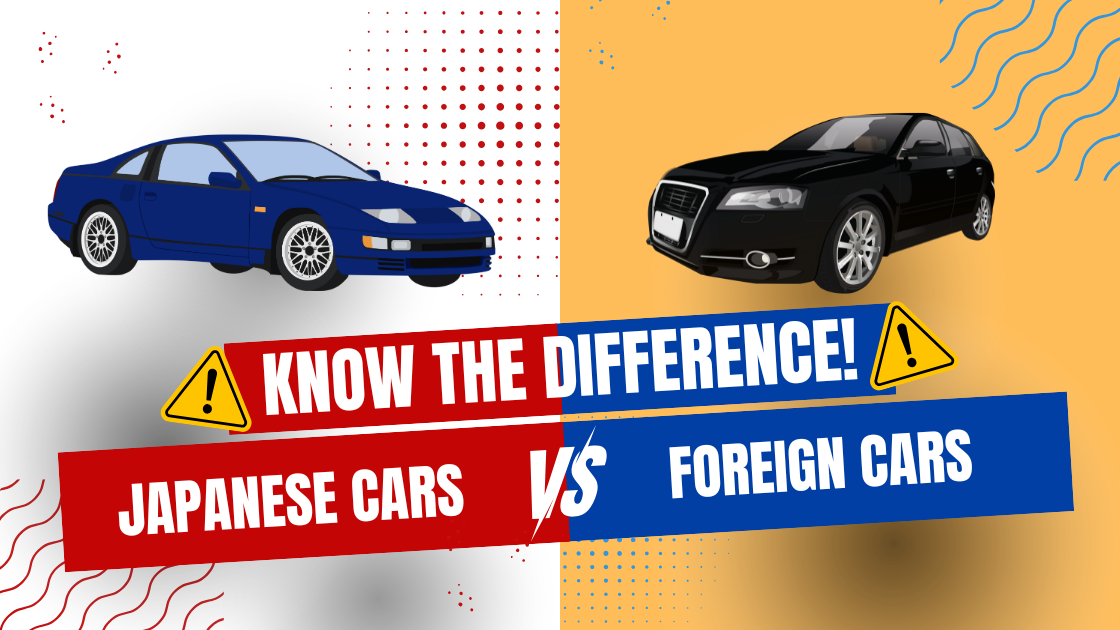
Japanese and foreign cars have variety of differences and each have superior points. It brings people to consider a lot when they think about purchasing a car for driving in Japan. In this article, we will talk about the main 6 differences between Japanese and foreign cars focusing on the driving performance, comfort, environmental friendliness, etc.
Contents
The difference between Japanese and foreign cars.
l Design
l Driving Performance
l Comfort
l Safety Performance
l Environmental Friendliness
l Maintenance Fee
Let’s dig them more!
Design
In design, foreign cars are said to be superior to Japanese cars. Because, Japanese cars cannot be elaborate in their exterior design because the value was placed on enhancing comfort while keeping the car small enough to drive on Japan’s narrow roads. In fact, many cars that place more emphasis on function than design have been released in Japan. Foreign cars place great importance on their own brand image, and in order to push through a design that is unique to their brand, it is easy to recognize that they are made by the same manufacturer, even if they are different car models.
On the other hand, Japanese cars incorporate different designs for each model, making it difficult to recognize something like a “manufacturer’s character”. Therefore, many people seem to fall in love with the “traditional yet advanced design sense” of foreign cars.
Driving Performance
The biggest difference in driving performance is the speed at which they excel. Japanese cars are designed for driving in urban areas with frequent starting and stopping at traffic lights. The maximum speed is generally 140 km/h, with 60 km/h being a comfortable speed.
On the other hand, foreign cars are designed for speeds in excess of 200 km/h. As a result, many of these cars are characterized by high handling performance, easy handling, and sturdy bodies that can withstand engine power and road impacts. Because of these characteristics When driving at high speeds, foreign cars are definitely more stable, powerful, and smooth. Conversely, for city driving, Japanese cars are lighter and more maneuverable. French and Italian cars, although foreign, are also often driven in the same small size as Japanese cars. Because the roads are often cobbled in many places, they have a “cat’s paw” undercarriage, which has good suspension and absorbs shocks, making them suitable for city driving.
Comfort
The comfort of the ride can only be experienced when the 3 factors of high driving performance, quietness and lack of shaking, and interior space are all present.
High driving performance refers to the ability to accelerate smoothly with a light touch on the accelerator pedal and the high handling performance that allows the driver to control the car freely according to the driver’s will. One of the criteria for a good ride is the feeling of joy of driving. Higher the speed, the better the driving performance of the foreign car.
The quietness and lack of shaking depends on whether a suspension with excellent shock absorption is used, whether the body is made of materials that absorb noise, and the comfort of the seats. If there is less noise and shaking, not only the driver but also passengers will be able to enjoy driving comfortably. Suspension is lighter in Japanese cars, and there is less shaking in city driving, but there is some instability at high speeds.
Seat comfort differs among manufacturers, but in general, foreign cars seem to be a step above. This is because foreign cars are built for long-distance driving and are not bound by price. In terms of overall ride comfort, foreign cars are superior.
Safety Performance
The difference in safety performance is that Japanese cars focus mainly on safety performance against pedestrians, while foreign cars focus on safety performance against automobiles. The differences come from the types of accidents that are likely to occur. For example, in terms of body, Japanese cars are made of materials that absorb the impact on pedestrians when they are hit by pedestrians, while foreign cars are built to absorb the impact on drivers when they are hit by cars. Safety devices, especially those using sensors and cameras, have been advancing year by year for both types of cars, with various safety features such as lane departure control, collision avoidance systems, rear-view monitors, and parking assist functions. If you are going to drive in Japan, it can be said that Japanese cars have higher safety performance in response to accidents that occur in Japan.
Environmental Friendliness
In Japan, the hybrid models are mainstream these days. Fuel-efficient, quiet-running, and high-performance hybrid vehicles are suitable for city driving in Japan’s narrow urban areas. On the other hand, down-sized turbo and clean diesel engines are mainstream for foreign cars.
In other countries, people tend to demand not only high fuel efficiency but also high driving performance. Although there is an image of “foreign cars are not fuel-efficient, nowadays many cars, especially European cars, are more stable at high speeds and offer good fuel economy. Cars that are stable at high speeds and have good fuel efficiency are being developed due to the tightening of CO2 emission regulations and the need to be more environmentally conscious in vehicle manufacturing. For example, the “Mini Cooper SE Crossover ALL4” has a nominal EV driving range of 42.4 km on a full charge and excellent fuel economy of 17.6 km/L. Thus, although Japanese cars have the upper hand in terms of environmental friendliness, it is expected that more environmentally friendly cars will be released by foreign automakers in the future.
Maintenance Fee
The maintenance fee of a car in Japan can be divided into the 4 major categories.
l Tax: Automobile tax or light automobile tax and automobile weight tax
l Insurance premiums: Compulsory Automobile Liability Insurance and voluntary insurance
l Fuel costs: including gasoline and electricity, parking and highway fees
l Maintenance costs: Costs for vehicle inspections and legal inspections, oil and oil element replacement, brake pad replacement, tire replacement, etc.
Of the above, there is no difference in automobile tax between Japanese and foreign cars, but the weight tax may be higher for foreign cars because of their heavier weight.
In addition, the premiums for liability insurance are the same, but those for voluntary insurance tend to be higher for foreign cars. The reasons why premiums for voluntary insurance are higher for foreign cars are “they are more likely to speed and cause accidents” and repair costs are higher. Gasoline costs depend on fuel economy, but tend to be higher for foreign cars because many of them are fueled by gasoline called high-octane.
Maintenance is more frequent for foreign cars, and if they are not maintained regularly, they tend to break down more often. In addition, if replacement parts need to be ordered from overseas, transportation costs are also involved, so maintenance costs can be 2-3 times higher than those for Japanese cars. In terms of maintenance costs, Japanese cars can be cheaper in terms of voluntary insurance, gasoline, and maintenance costs.
Decide whether to buy a Japanese or foreign car based on what is important to you.
So far, the differences between Japanese cars and foreign cars are explained. Overall, foreign cars are superior in terms of driving performance, comfort, and design sense, but Japanese cars are superior in terms of environmental friendliness and maintenance costs. Above all, Japanese cars are fuel-efficient and hard to break down, yet they are relatively affordable, making them an excellent cost-effective choice. If your basic use for a car is for daily city driving rather than long drives, a Japanese car is more suitable. However, if you want to be different and special, a foreign car may be a good choice. When deciding between a Japanese car and a foreign car, you should decide based on what you value most.