Contents
- Top 10 Japanese Traffic Rules That Foreigners Often Misunderstand
- 【No. 1】Pedestrians Have “Absolute” Priority at Crosswalks (Even Without a Traffic Light)
- 【No.2】 Driving on the Left and Right-Hand Drive
- 【No.3】Always Come to a Complete Stop and Check for Safety at Railroad Crossings
- 【No.4】The “Stop” Sign Requires a Complete Stop
- 【No. 5】As a general rule, a yellow light means “Stop”
- 【No. 6】 Strict Enforcement of Speeding Violations
- 【No.7】 Drunk Driving Is Strictly Prohibited
- 【No.8】 Oncoming Straight-Through Traffic Has the Right of Way When Turning Right
- 【No.9】Bicycles Are Also Classified as “Vehicles” (Blue Ticket System introduced in 2026)
- 【No.10】 Horns Are Rarely Used
- 【Summary】3 Fundamental Attitudes for Safe Driving
- Key References
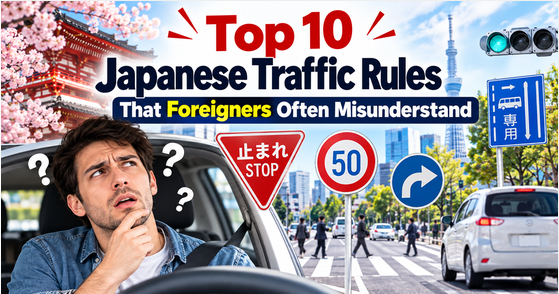
Top 10 Japanese Traffic Rules That Foreigners Often Misunderstand
We often hear from foreigners who have just started driving in Japan, or from companies that employ foreign drivers.
“I drove safely for years in my home country, but I got a traffic ticket in Japan.” “I was driving carefully, but I was surprised when the police pulled me over.”
In fact, in most cases, this isn’t a matter of driving skill—it’s simply a lack of knowledge about traffic rules unique to Japan. Many aspects of Japan’s traffic rules differ significantly from international standards. According to statistics from the National Police Agency, fatal and serious injury accidents caused by foreign drivers exceeded 2% of the total in the first half of 2025, reaching a record high.
In this article, we’ll present a ranked list of Japanese traffic rules that foreign drivers particularly tend to struggle with, based on their importance and the prevalence of misunderstandings.
【No. 1】Pedestrians Have “Absolute” Priority at Crosswalks (Even Without a Traffic Light)
This is probably the rule that is violated most frequently and yet is most often overlooked.
In Japan, if a pedestrian is about to cross or is currently crossing a crosswalk, vehicles must always come to a complete stop. Excuses such as “They haven’t started crossing yet” or “They’re just standing there” are not valid. Simply standing near a crosswalk triggers the obligation for vehicles to stop.
The penalties for violating this rule are severe: it is classified as “obstructing a pedestrian at a crosswalk,” resulting in 2 demerit points, a fine of 9,000 yen (for standard vehicles), and imprisonment for up to 3 months or a fine of up to 50,000 yen.
For those coming from countries with a culture that prioritizes vehicles, it takes time to get used to this mindset. On Japanese roads, always keep in mind the principle: “If you see a pedestrian, stop first.”
【No.2】 Driving on the Left and Right-Hand Drive
About 70% of the world’s countries drive on the right, while only a minority—including Japan, the United Kingdom, India, and Australia—drive on the left.
For drivers coming from right-hand-drive countries, everything about driving in Japan feels the opposite of what they’re used to. The following situations require particular caution:
- When merging onto the main road from a parking lot or side street, you may unconsciously drift into the right lane.
- After making a U-turn, you may instinctively return to the right lane.
- After turning left at an intersection, you may end up in the oncoming lane.
- On wide roads with no oncoming traffic, you may find yourself driving on the right side.
These unconscious mistakes can lead directly to serious accidents. During your first few weeks of driving in Japan, you need to be so cautious that you should consciously repeat to yourself, “Left, left.”
【No.3】Always Come to a Complete Stop and Check for Safety at Railroad Crossings
In many countries, coming to a complete stop at railroad crossings is not mandatory; drivers rely on the operation of the crossing gates and warning signals to determine whether to stop. However, in Japan, even if the gates are up and there are no signs of an oncoming train, you must always come to a complete stop immediately before the crossing and visually check both directions for safety.
Japan has a highly developed railway network, and this strict rule has been established to prevent accidents at railroad crossings. Simply “slowing down” or “thinking you stopped for a moment” constitutes a violation. A “complete stop”—where the tires come to a complete halt—is required.
Furthermore, to avoid getting stuck on the tracks, it is important to confirm that there is enough space to proceed beyond the crossing before crossing. During traffic jams or similar situations, you may need to decide to wait just before the crossing.
【No.4】The “Stop” Sign Requires a Complete Stop
Japan’s “Stop” sign is a red, inverted triangle that bears the Japanese word “止まれ” and, on some signs, with the English word “STOP.”
The problem is that because its shape differs from the red octagonal “STOP” sign used in many countries around the world, many foreign drivers do not even realize it is a stop sign in the first place. Studies on foreign visitors renting cars in Japan have also reported a high number of traffic violations at intersections without traffic lights, particularly accidents caused by failing to come to a complete stop.
While the red octagonal “STOP” sign is the international standard, the inverted triangle is the norm in Japan. If you see a red inverted triangle sign, you must immediately recognize it as a “Stop” sign.
Just like at railroad crossings, a complete stop—where the tires come to a complete halt—is mandatory. “I slowed down and proceeded because it seemed safe” is treated as a violation.
【No. 5】As a general rule, a yellow light means “Stop”
Under Japan’s Road Traffic Act, a yellow light means “You must not proceed past the stop line (except when it is impossible to stop safely).” In other words, the general rule is “Stop,” and the idea is that you may proceed only in exceptional cases where it is impossible to stop safely.
In contrast, in many countries, a yellow light is interpreted to mean “proceed with caution,” and drivers who follow Japan’s rules for yellow lights may even be met with confusion, such as “Why did you stop?”
Flashing yellow lights add another layer of complexity. In Japan, a flashing yellow light means “proceed with caution, watching out for other traffic,” and there is no obligation to stop. Because the meaning differs even though the color is the same, this is a point that often confuses foreign visitors.
【No. 6】 Strict Enforcement of Speeding Violations
On general roads in Japan, the legal speed limit is generally 60 km/h unless otherwise indicated by a sign. However, residential areas often have a 30 km/h speed limit, and enforcement is particularly strict on local streets.
Claims such as “Other cars are driving at the same speed” or “I couldn’t see a speed limit sign” are not valid excuses for a violation. Enforcement is frequent through the use of speed cameras (automatic speed enforcement devices), unmarked patrol cars, and speed traps, and you will not be let off just because you are a foreigner.
The legal speed limit on expressways is 100 km/h for standard passenger cars (120 km/h on some sections), but the general rule is to follow the instructions on the signs.
【No.7】 Drunk Driving Is Strictly Prohibited
Japan’s strict stance on drunk driving ranks among the toughest in the world.
- Driving under the influence: A violation occurs when the breath alcohol concentration is 0.15 mg/L or higher (in many Western countries, the standard is 0.05%).
- Driving while intoxicated: A violation occurs when the breath alcohol concentration is 0.5 mg/L or higher, or when the driver is unable to drive normally.
- Penalties: Driving with alcohol in the system carries a penalty of up to 3 years’ imprisonment or a fine of up to 500,000 yen; driving while intoxicated carries a penalty of up to 5 years’ imprisonment or a fine of up to 1 million yen.
Another important point to note is the concept of “joint liability.” Not only the driver but also the person who provided the vehicle, the person who provided the alcohol, and even passengers who rode along knowing the driver was under the influence are subject to penalties. This means that even at a company drinking party, you could face charges simply for encouraging a colleague who plans to drive home to have a drink.
The excuse “just one drink” absolutely does not hold up. In Japan, the rule is that if you plan to drive, you must not consume any alcohol at all.
【No.8】 Oncoming Straight-Through Traffic Has the Right of Way When Turning Right
When turning right at a signalized intersection, oncoming straight-through traffic and left-turning vehicles in the opposite lane always have the right of way. Even when the light is green, right-turning vehicles must wait within the intersection as long as there is oncoming straight-through traffic.
If you are accustomed to the “Right on Red” rule, as in the United States, you must NOT do this in Japan. In Japan, turning right or left on a red light—except when a green arrow signal is displayed—is considered running a red light.
In addition, there are the following specific precautions to take when turning right:
- Enter the intersection until you are near the center before turning right (tight turns are prohibited)
- Watch out for pedestrians at the crosswalk where you are turning right (pedestrians have the right of way here as well)
- If a vehicle is turning right from the oncoming lane, as a general rule, pass it in a “right-to-right” position, moving in front of the vehicle.
【No.9】Bicycles Are Also Classified as “Vehicles” (Blue Ticket System introduced in 2026)
In Japan, bicycles are classified as “light vehicles” under the Road Traffic Act, and as a general rule, they must travel on the left side of the roadway. Riding on sidewalks is treated as an exception; even when permitted, pedestrians have the right of way, and cyclists must proceed at a slow speed.
Starting in April 2026, the “blue ticket” (traffic fine system) for bicycle traffic violations will be fully implemented. The following violations will be subject to fines:
- Running a red light
- Failing to stop at a stop sign
- Riding without lights (at night)
- Riding while holding an umbrella
- Riding while using a smartphone
- Riding while wearing earphones (to the extent that you cannot hear surrounding sounds)
- Riding with a passenger (with some exceptions)
If you take cycling lightly in Japan—thinking, “It’s just a bicycle”—you will be issued a traffic ticket. In particular, riding without lights and using a smartphone while riding are key enforcement priorities.
【No.10】 Horns Are Rarely Used
While it isn’t a legal violation, the “cultural rule” that confuses foreigners the most is the use of horns.
Under Japan’s Road Traffic Act, horns (audible warning devices) may only be used “when absolutely necessary to prevent danger” or in areas where there is a “Sound Horn” sign. Unnecessary use of horns in other locations constitutes a “violation of restrictions on the use of audible warning devices.”
In many countries, car horns are used for a variety of purposes—such as to get someone’s attention, urge someone to move faster, or say “thank you”—but in Japan, honking on a daily basis not only startles other drivers but can also lead to trouble.
The Japanese way to thank someone for yielding the right of way is to give a light wave or a slight bow.
【Summary】3 Fundamental Attitudes for Safe Driving
We’ve introduced 10 rules that foreigners often misunderstand, but the most important mindsets are following 3 things.
- Thoroughly practice “anticipatory driving.” In Japan, there is a strong emphasis on driving while constantly anticipating that a pedestrian might be crossing or an oncoming vehicle might appear.
- Aim for driving with “clear distinction.” Come to a complete stop where you’re supposed to stop, look carefully with your own eyes where you need to check, and proceed at an appropriate speed when moving forward. This “clear distinction” is a hallmark of Japanese traffic culture.
- When in doubt, “give priority to pedestrians and cyclists.” In Japan, pedestrians and cyclists have the right of way. If you’re unsure what to do, always give priority to vulnerable road users first. By adhering to this principle, you can avoid major violations and accidents.
Japan’s traffic rules are certainly strict and unique. However, it is precisely this strictness that keeps Japan’s traffic fatality rate among the lowest in the world. Please understand the rules correctly and enjoy a safe and comfortable driving experience in Japan.
Key References
- Cabinet Office, “Reiwa 7 Road Safety White Paper”
- National Police Agency, Road Safety Leaflet for Foreign Drivers
- Immigration Services Agency of Japan, “Guidebook for Living and Working in Japan,” Chapter 9: Transportation (Available in 19 Languages)
- Traffic rule awareness materials for foreign nationals from prefectural police departments (e.g., Tokyo Metropolitan Police Department, Saga Prefectural Police)
- JAF (Japan Automobile Federation), Traffic Rule Videos for Foreign Visitors to Japan
Notes: This article is based on information current as of 2026. Traffic rules are subject to change, so please check the official websites of the National Police Agency and your local prefectural police department for the latest information.