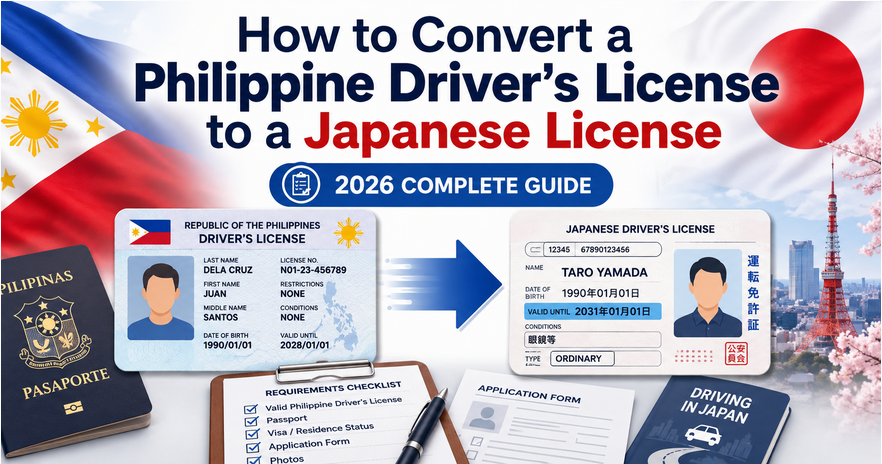
Would you like to convert your Philippine driver’s license to a Japanese one? A driver’s license is essential for living and working in Japan, isn’t it?
However, due to regulatory changes effective October 1, 2025, the process for converting foreign driver’s licenses has become significantly stricter. In particular, since the Philippines is not included among the 29 countries and regions exempt from the written exam, you must take both the written and practical exams under the new, stricter standards. Furthermore, there is the additional hurdle of the “official receipt,” a document unique to the Philippines.
In this article, based on the latest regulations as of 2026, we will provide a comprehensive guide to the process of converting a Philippine driver’s license to a Japanese one—covering everything from application requirements and necessary documents to test preparation.
Contents
- Key Points to Keep in Mind First
- Eligibility Requirements
- A Complete List of Required Documents
- Where to Obtain a Japanese Translation of Your License
- Application Process Flow
- Contents and Preparation for the Written Exam (Knowledge Assessment)
- Contents and Preparation for the Skills Test (Practical Test)
- Estimated Costs
- Important considerations after obtaining your license
- Summary: 3 Tips for Success
Key Points to Keep in Mind First
There are three key points you should understand before considering a license conversion from the Philippines.
-
The Philippines is not eligible for the exam exemption.
Holders of driver’s licenses from 29 countries and regions (including Germany, South Korea, and Taiwan) that are considered to have a licensing system equivalent to Japan’s are exempt from the written and practical exams. However, the Philippines is not included in this list. This means that, in addition to the aptitude test, you must take both the written exam (theory) and the practical exam (driving skills).
-
The Philippines is not a signatory to the Geneva Convention
Since the Philippines is not a signatory to the Geneva Convention, you cannot drive in Japan with an international driver’s license issued by the Philippines. To drive in Japan, you must either convert your foreign license to a Japanese license or obtain a new Japanese license from scratch.
-
The system has become significantly stricter starting in October 2025
The written exam has been expanded from 10 questions to 50, and the passing score has been raised from 70% to 90%. The practical exam is now graded just as strictly as for first-time applicants. Unfortunately, holders of Philippine driver’s licenses will be fully affected by these stricter requirements.
Eligibility Requirements
To apply for a conversion of a foreign driver’s license, you must meet all of the following conditions:
-
You must hold a valid driver’s license issued by the Philippine Land Transportation Office (LTO).
-
You must have resided in the Philippines for a total of at least 3 months since obtaining your Philippine license (this does not include the number of days spent in Japan).
-
Your Philippine license must not have expired.
-
Your status of residence must NOT be a short-term stay such as a tourist visa (you must be a medium- to long-term resident eligible to obtain a certificate of residence)
-
You must be at least 17 years and 6 months old (for a standard driver’s license, issuance is restricted to those 18 years of age or older)
-
You must meet the physical fitness standards, including vision requirements (for standard and motorcycle licenses: 0.7 or higher in both eyes, and 0.3 or higher in each eye)
Please note that, particularly following the October 2025 amendment, short-term visitors such as those on tourist visas are effectively ineligible to apply. Since a copy of the Resident Record is required, this system is now intended for medium- to long-term residents who hold a Residence Card.
A Complete List of Required Documents
In addition to the general required documents, several documents specific to the Philippines are required to convert a foreign driver’s license to a Japanese one. This is a hurdle unique to the Philippines that applicants from other countries do not face.
General Required Documents
-
Copy of Resident Certificate (must include registered domicile, nationality, status of residence, and period of stay; must not include “My Number”)
-
Residence Card (original)
-
Passport (bring any old ones you have)
-
One passport-sized photo (3 cm tall × 2.4 cm wide, taken within the last 6 months, bareheaded, facing forward, plain background)
-
Valid Philippine driver’s license (original; copies not accepted)
-
Japanese translation of the Philippine driver’s license
Additional documents specific to the Philippines
-
Official Receipt (serves as both a receipt and a provisional license)
This is the biggest hurdle for applicants from the Philippines. The Official Receipt is a receipt for the license issuance fee issued by the LTO. Even within the Philippines, the license itself has no official validity; the authenticity of the license is only proven with this receipt. It must include the license number and the date of issuance.
It is very common for applicants to arrive in Japan without this document. A frequent scenario is discovering the lack of an Official Receipt after starting the application process for a foreign license conversion, leading to a request for family or acquaintances in the Philippines to mail it.
If the document is lost, it may be possible to substitute it by obtaining a “Certification of License” (Driving License History Certificate) from the LTO.
-
LTO-Issued Certificate and Apostille (Required by some prefectures)
Depending on the prefecture, in addition to the LTO-issued certificate itself, an Apostille (an authentication of public documents issued by the Philippine Department of Foreign Affairs, or DFA) may be required to verify its authenticity. The Toyama Prefectural Police, for example, explicitly require both an Apostille and an official receipt from Filipino applicants. Since obtaining an Apostille must be done at the DFA in Manila, this process can take an entire day for those living in regional areas.
-
Documents proving a stay of three months or longer
While entry and exit stamps in your passport are the standard proof, if no stamps were applied (e.g., due to using automated immigration gates) or if the stamps are illegible, you will need to request official entry and exit records from the Philippine Bureau of Immigration. Since this process takes time, please allow plenty of time for preparation.
Where to Obtain a Japanese Translation of Your License
A Japanese translation of your Philippine driver’s license is required to convert to a Japanese license. Translations done by yourself or by general translation agencies will not be accepted, so you must have it issued by an agency designated by the National Public Safety Commission.The main translation agencies that handle Philippine driver’s licenses are as follows:
Please note that JAF’s translation fee was revised from 4,000 yen to 6,000 yen on April 1, 2026.When requesting a translation of a Philippine driver’s license via JAF’s online application, you must attach image files of: (1) the front of the license, (2) the back of the license, and (3) the official receipt. If you do not have the official receipt on hand, an image of the driver’s license certificate issued by the LTO may be accepted as a substitute in some cases; however, the original document will ultimately be required during the subsequent review by the Driver’s License Center, so we recommend obtaining it as soon as possible.
Application Process Flow
The actual application process generally proceeds in the following eight steps:
Step 1: Gather the Required Documents
The most time-consuming steps are obtaining the translated documents and securing additional documents from the Philippines (such as official receipts and apostilles). This can take anywhere from several weeks to several months.
Step 2: Make an Appointment at the Competent Driver’s License Center
The foreign license conversion process operates on an appointment-only basis. You can make an appointment by phone or in person at the office. Since the system reforms in October 2025, the number of applicants has surged, and it is not uncommon for some areas to have waiting lists of several months.
Step 3: Document Review (Preliminary Screening)
If your documents are incomplete, you will not be able to proceed with the process on the spot and will need to reschedule for another day. For applicants from the Philippines, there have been frequent cases where applications were rejected due to issues with the official receipt.
Step 4: Physical Examination
This involves checking your vision, hearing, and physical abilities.
Step 5: Knowledge Test (Written Exam)
50 multiple-choice questions in 30 minutes. A score of 45 or more correct answers (90% or higher) is required to pass. The exam is available in 21 languages, including Tagalog.
Step 6: Skills Test (Practical Exam)
You will drive on a closed course. A score of 70 or higher out of 100 (on a penalty point system) is required to pass.
Step 7: License Issuance
After passing, your license will be issued on the same day or at a later date.
Step 8: (Optional) Obtaining a “My Number License”
If you bring a valid “My Number Card”, you can also receive your license as a My Number License.
Contents and Preparation for the Written Exam (Knowledge Assessment)
With the amendments in October 2025, the difficulty level of the written exam has become nearly equivalent to that for obtaining a new license.
The passing margin is strict, allowing only up to 5 mistakes. While it is reassuring that the exam can be taken in Tagalog—allowing those who are unsure of their Japanese to take it in their native language—the fact remains that the content itself has become more difficult.
According to an announcement by the National Police Agency, the pass rate for the knowledge assessment after the stricter standards were implemented (October–December 2025) dropped to 42.8%. This is less than half of the 92.5% rate prior to the amendments. Please understand that the era of this being an easy exam to pass is completely over.
As a countermeasure, it is effective to utilize specialized learning tools for foreigners, such as the AI learning service “Drivey” provided by Zipplus Co., Ltd. Use learning materials that support multiple languages, including Tagalog, to get accustomed to questions at the full license level.
Contents and Preparation for the Skills Test (Practical Test)
The skills test is the biggest hurdle for applicants from the Philippines. The reason is simple: the driving environments in the Philippines and Japan are completely opposite.
Differences in Driving Environments: Philippines vs. Japan
-
Traffic Flow: The Philippines drives on the right / Japan drives on the left
-
Steering Wheel: The Philippines has left-hand drive / Japan has right-hand drive
-
Driving Culture: The Philippines follows a “as long as you don’t crash, it’s okay” approach / Japan emphasizes precise safety checks
Since right-hand drive vehicles are prohibited in the Philippines, drivers accustomed to driving there are completely optimized for left-hand drive and right-hand traffic. Because the Japanese traffic environment feels completely reversed, you must correct unconscious habits—from how you position yourself in lanes and how you maneuver when turning left or right, to the direction you check your mirrors.
Test Content Following the Tightening of Standards
Following the amendments in October 2025, the skills test has changed as follows:
-
Total driving distance of 1,200 meters or more (prior to the amendment, it was generally around 1,200 meters, though some prefectures had distances of around 500 meters)
-
At least three different course types must be set
-
Circular curves, passing through crosswalks, passing through railroad crossings, and driving on a hill course have been added as mandatory tasks
-
Many items that previously incurred special penalty points (first mistake overlooked, second mistake penalized) now result in immediate penalty points.
-
Stricter scoring, similar to that for first-time license applicants, is applied to violations such as failure to signal or improper turning.
While the passing standard remains at 70 points or higher out of 100, the opportunities for penalty points have increased significantly. The passing rate for the practical test after the stricter standards was 13.1% (30.4% before the amendment). Prefectural data has also been reported, showing that in Mie Prefecture, only 3 out of 87 candidates passed; in Shizuoka Prefecture, the pass rate dropped from 93% to 38%; and in Aichi Prefecture, it fell from 94% to 34.9%.
Common reasons for point deductions
The following are common reasons why Filipino test-takers often fail:
-
Checking left and right too late
-
Failing to check for vehicles in blind spots (due to the habit of driving on the right side of the road, they tend to look in the opposite direction)
-
Insufficient pulling over when turning right or left
-
Signaling too early or too late
-
Insufficient safety checks on narrow roads
-
Incorrect stopping procedure at railroad crossings
-
Lack of awareness of pedestrian priority at crosswalks
Preparation at a driving school is virtually essential
Given the extremely low practical test pass rate of 13.1%, passing the test through self-study is not realistic. Taking preparatory courses at a driving school that specializes in foreign license conversion is practically essential.
The standard cost for practical training at a driving school is around 30,000 to 50,000 yen for 2 to 3 hours. While it is possible to practice using the open practice courses at the license center, attending a driving school where you can receive feedback from an instructor is more efficient. The number of driving schools offering specialized courses for foreigners, including Filipinos, is increasing, so please look for a driving school in your area that handles foreign license conversion.
Estimated Costs
The estimated costs for converting a foreign driver’s license are as follows:
The total cost is estimated to be approximately 30,000–100,000 yen. This amount varies significantly depending on whether you attend a driving school and the number of retakes required.
Important considerations after obtaining your license
Even after successfully obtaining your Japanese driver’s license, there are several important points to keep in mind.
Validity Period and Renewal
As a general rule, the license is valid for 3 or 5 years, based on your birthday. When renewing, you will need to provide a copy of your Residence Card or Resident Certificate.
Obligation to Display the Novice Driver Mark
Under Japanese regulations, individuals who obtain a standard driver’s license by converting a foreign license are treated as novice drivers. Therefore, you are required to display the novice driver mark on the front and rear of your vehicle for one year from the date of issuance. Even if you have driven in the Philippines for many years, you will be treated the same as someone who has just obtained a license in Japan.
However, in some jurisdictions, such as the Kanagawa Prefectural Police, the novice driver period may be waived if you can prove that you have resided in Japan for a total of one year or more after obtaining your foreign license. Please check with the police department in your prefecture.
Continuously Learn Japanese Traffic Rules
Japanese roads have many unique traffic rules and etiquette that you may not have encountered in the Philippines. Even after obtaining your license, continue to learn Japanese traffic rules to ensure safe driving.
Summary: 3 Tips for Success
Finally, here are three tips to help you smoothly convert your Philippine driver’s license to a Japanese one.
-
Gather your documents early and make sure they’re complete
Obtaining official receipts and apostilles takes time. Ideally, you should start preparing before arriving in Japan, but even if you’re already here, ask your family or friends in the Philippines to gather the documents as soon as possible. Having to visit the driver’s license center multiple times due to incomplete paperwork is a huge waste of time and energy.
-
Take the written test in your native language, and the practical test at a driving school
You can take the written test in Tagalog, so there’s no need to force yourself to take it in Japanese. On the other hand, the practical test is subject to stricter standards, so we recommend preparing at a driving school that specializes in converting foreign licenses. Don’t let your guard down just because you’ve driven in the Philippines.
-
Choose the Right Time to Apply
Since the system reforms in October 2025, waiting lists at driver’s license centers across the country have been several months long. If your Philippine license is nearing its expiration date, you need to be especially careful. Since your Philippine license must remain valid until you pass the practical exam, if you have less than a month left before it expires, it’s safer to renew your license in the Philippines first.
The process of converting a foreign driver’s license can be a long journey—taking six months or more for some people, starting from the document preparation stage. However, it is a process that you can definitely complete if you prepare thoroughly. Please refer to this article and proceed with careful planning.
Key Reference Information
-
Tokyo Metropolitan Police Department: How to Convert a Foreign Driver’s License to a Japanese Driver’s License (Updated April 15, 2026)
-
National Police Agency: Status of Foreign Driver’s License Conversion Exams (Published March 2026)
-
Embassy of Japan in the Philippines: Driver’s License Information
-
Guidance on Foreign Driver’s License Conversion from Prefectural Police Departments (Kanagawa Prefectural Police, Toyama Prefectural Police, Nagasaki Prefectural Police, Hyogo Prefectural Police, etc.)
*Procedures may vary in detail depending on the prefecture. Before applying, please be sure to check with the Driver’s License Center that has jurisdiction over your area of residence.