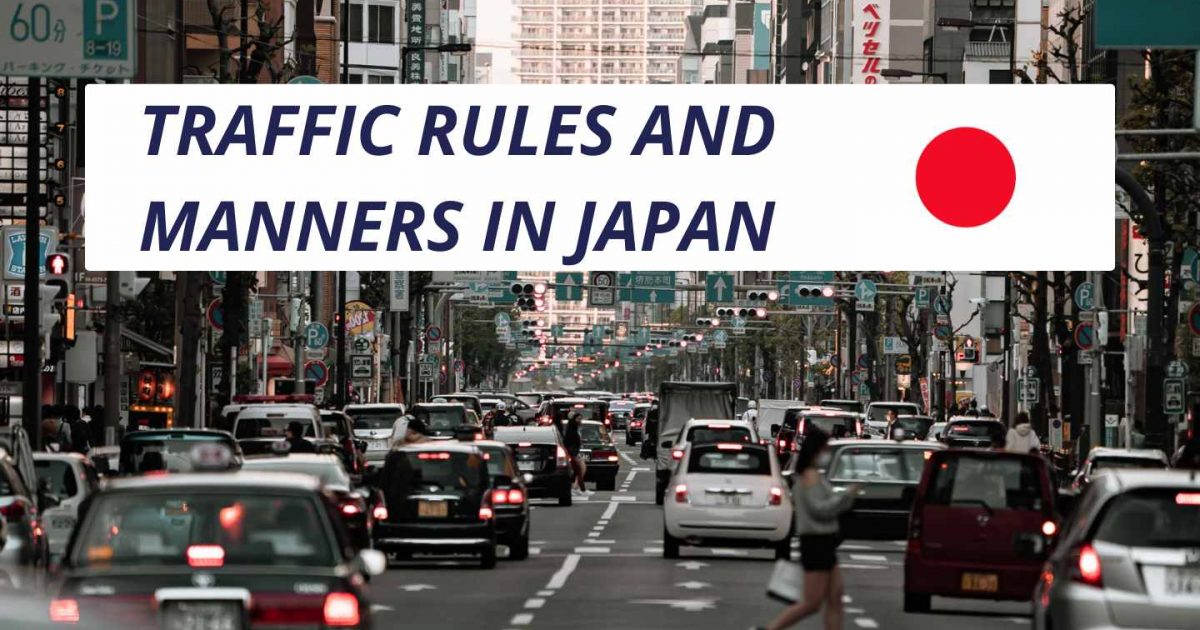
Traffic rules and manners are confusing to foreigners when driving in Japan. For those who have driven in other countries, Japanese traffic rules may seem unique. It is important to understand Japanese traffic rules before driving, as one wrong move can cause a serious accident. In this article, we will focus on the key points of Japanese traffic rules and manners that foreigners should know in advance.
Contents
- Cars should drive on the left side of the road
- Pause at railroad crossings
- Detailed speed limits are set
- Parking on the street outside the designated area is a parking violation
- Inverted triangles are used for “Stop” signs
- At intersections without traffic signal, the left side of the road has priority
- Always give priority to pedestrians
- Penalties for horn use.
- Traffic signals turn on in the following order: blue, yellow, red
- Hazard lights mean “Thank you”
- Drive safely and observe Japanese traffic rules and manners!
Cars should drive on the left side of the road
Japanese cars drive on the left side of the road. This is unusual compared to the rest of the world. Many countries have right-of-way. The Road Traffic Law of 1960 (Showa 35) established that vehicles must pass on the left side of the road, starting from the center of the road. Earlier, in 1881 (Meiji 14), it was stipulated that vehicles should pass on the left side of the road, saying, “If rickshaws pass each other, avoid them on the left. In addition, according to an earlier legend, samurai used to carry their swords on the left side of the road so that their sheaths would not collide with each other. In Okinawa Prefecture, which was under U.S. rule after the war, vehicles drove on the right side of the road, but on July 30, 1978 (Showa 53), they began driving on the left side of the road, the same as on the mainland.
Pause at railroad crossings
In Japan, it is required to pause in front of railroad crossings. You must always pause even when the breaker is up and there is no train coming. In urban areas in Japan, the railroad network is particularly well developed, and there are numerous railroad crossings. Cars must pause in order to prevent an accident in which is trapped on the tracks because it cannot cross before the breaker is lowered.
Detailed speed limits are set
In Japan, speed limits are defined in detail. For example, the basic rate for urban roads is 40 km/h, 20-30 km/h for residential areas, 80-100 km/h for expressways, and 50-60 km/h for other roads. Drive accordingly to the speed limit indicated by the road signs. Speeding is one of the most frequently cited traffic violations in Japan. One of the reasons for the high number of speeding violations is the lack of speed cameras on Japanese roads. However, the police are frequently enforcing speeding laws, so please drive safely and do not get caught up with other cars and drive too fast.
Parking on the street outside the designated area is a parking violation
In Japan, parking on the street outside of designated areas is a parking violation. If a car is parked in a place where parking is prohibited, a yellow sticker called an “Abandoned Vehicle Identification Marker” will be affixed, and the driver who has the sticker must report to the police station. Places where parking is prohibited are designated as “no-parking areas” and places where both parking and stopping are prohibited are designated as “no-parking, no-stopping areas”.
Parking is prohibited in the following places.
l Places where there are no-parking signs or signs indicating that parking is prohibited
l Within 3m from entrances and exits for vehicles such as parking lots and garages
l Within 1m from fire alarms
l Within 5m from fire-fighting machinery and equipment storage areas and fire prevention water tanks
l Within 5m from fire hydrants, designated fire water signs, and water inlets of fire water tanks
l Within 5m from the edge of the road construction zone
Both parking and stopping are prohibited in the following places.
l Locations where there are no parking signs or signs prohibiting parking
l Within 5m of a pedestrian crossing or bicycle crossing zone
l Within a 10-meter radius of a bus stop or tram stop
l Within an intersection, pedestrian crossing, bicycle crossing, railroad crossing, or track bed (e.g., on streetcar tracks)
l Within 5m from the edge of an intersection or road turn
l Within 10 m from the edge of a railroad crossing
l Near the top of a slope, steep slope
l In tunnels
l Within 10 meters from the left side of the safety zone and from the front and rear of it
You may not park in any other place where you cannot take more than 3.5 meters of room on the right side of your car. Also, parking in the same spot on the road for more than 12 hours, or more than 8 hours at night, is also a parking violation.]
Inverted triangles are used for “Stop” signs
In Japan, “Stop” signs are red inverted triangles, but in other countries, red octagons are the norm. In Japan, the “Stop sign” is a red inverted triangle. Therefore, those who come to Japan from abroad seem to find it difficult to understand “Stop sign”. Under the postwar GHQ Administration Division, the concept of “Stop” was introduced for the first time in 1950 (Showa 25), and the sign design was the same as the American sign design. However, it was changed to an inverted triangle design in 1963.
As well as “Stop,” there is another sign that is unique to Japan, “proceed slowly”. The word “slow” means “proceed at a speed that will allow the vehicle to stop immediately”. Outside of Japan, the inverted triangle sign means “give away” to the vehicle in front. In the U.S., “slow down” is represented by a yellow diamond-shaped warning sign, so you need to be careful not to make a mistake.
At intersections without traffic signal, the left side of the road has priority
In Japan, there is a leftward priority rule. What is leftward priority? At a crossroads, where there is no traffic signal and priority are not clearly defined, priority is given to vehicles entering the intersection from the left. If an accident occurs at an intersection without a traffic light, the car on the left will be less at fault. Conversely, if you are driving on the right side of the road as seen by the other party, you must give priority to the other car. This is the case when there are no traffic signal signs and the width of the intersecting roads are the same.
At crossroads with vehicular traffic zones, left-hand priority does not apply because the traffic rule is that the road through the vehicular traffic zone is the priority road.
Always give priority to pedestrians
Pedestrians have priority at crosswalks. When you see a crosswalk, drive at a speed that allows you to stop in front of the crosswalk, and be sure to pause if there are pedestrians.
What should a car do on a road without a pedestrian crossing? In Japan, Article 38-2 of the Road Traffic Law stipulates that “Vehicles shall not obstruct pedestrians crossing a road at an intersection or in its vicinity where there is no pedestrian crossing. In all cases, pedestrians must always be given priority. If you obstruct a pedestrian who is attempting to cross the road, it is an offense of “obstructing a pedestrian crossing the road” and is punishable by up to 3 months imprisonment or a fine of up to 50,000 yen. The penalty is 2 points and 9,000 yen for a standard car.
Penalties for horn use.
Some people use the horn to greet others or to thank them for giving way, but this is actually a traffic violation. A horn is called an “alarm device” under the Road Traffic Law. Article 54, Paragraph 2 of the Road Traffic Law states, “The driver of a vehicle shall not sound an alarm except when the law requires him to do so. However, this shall not apply when it is unavoidable in order to prevent danger.” and should only be sounded at the time. Only where there is a road sign that says “honk” which are placed mainly in mountainous areas where visibility is poor, such as around curves, bends, and at the top of hills.
At these locations, you must sound your horn to alert others of your vehicle’s presence, regardless of whether or not there is a danger. If you sound the horn even though there is no “Sound the horn” sign, you will be charged with a “Restricted use of horn” violation and will not receive points for the offense, but will be fined 3,000 yen.
Traffic signals turn on in the following order: blue, yellow, red
In Japan, traffic lights are in the order of “blue, yellow, red”. Traffic lights are also in the order of “blue, yellow, red” from left to right. A green light means “proceed”. A yellow light means “stop,” but if you are crossing the stop line or cannot stop safely, proceed. A red light means “stop. In some foreign countries, people are allowed to turn right even at a red light, but in Japan, you must stop completely. However, if there is a green arrow below the traffic signals, you may proceed in that direction even if the light is red.
Hazard lights mean “Thank you”
In Japan, the “Thank You Hazard” is commonly used to flash the hazard lights two or three times when someone give the right of way. When a car changes lanes and flashes its hazard lights, it is a “thank you” hazard and not an emergency.
Drive safely and observe Japanese traffic rules and manners!
We have introduced Japanese traffic rules and manners that foreigners should know. The penalties for traffic rules in Japan are severe. It is not acceptable to say, “I didn’t know,” so be sure to research the traffic rules thoroughly before driving. Traffic rules are for your safety. Follow the rules and drive safely!